A brief history.
As far as I know, the Wetmore family walked all the way to Delaware county from NYC off the ship from Scotland in the 1700s and settled this farm, originally of 400 acres. They built a total of 5 buildings. A Greek revival house and a small barn by the road in the early 1700s. Another ‘scribe’ barn was built in late 1700s. Then a carriage house was built in 1864 and the last architectural structure they built was a large triple deck bank barn with 2 bridge-ways entering on the third level. That was 1911 when the barn builder Billy Boggs built one of his last structures.
The barn functioned as an agricultural building until around 1976 when the farm was sold and the property divided and sold in parcels. The parcel with the barns, 13 acres, has changed ownership 3 times. The last time in 2000.
Throughout Billy Barn’s history many modifications had been performed. Support posts cut out and massive amounts of concrete poured when the barn was modernized with a poop removal device.
Since 2000 we have been on mission to preserve and repurpose the barn, a too long and costly mission.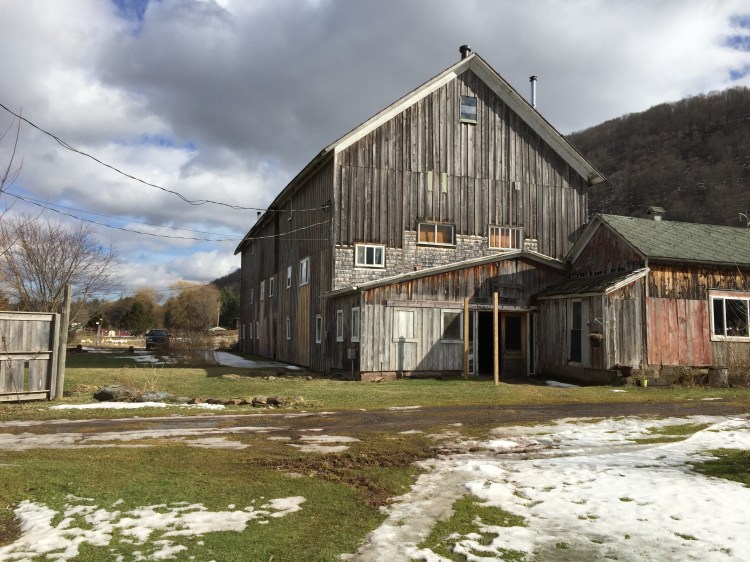


Billy Barn had 4 silos one time. Two were on the street side of the barn, one built inside the barn and a newer glass sealed blue metal silo on the mountain side of the barn. The two silos up front were gone by the time I got here. They were buried right where they fell and the steel bands stick out the ground. I had to plant Bee Balm around the steel rods to cover them up. A lot of the silo wood wound up inside the carriage house as wall panels running horizontally.
The metal silo, new technology must have cost a fortune to install, tons of concrete. Many farms went under paying for these silos. Now silos are obsolete, just wrap the hay in plastic. I gave that silo to a guy who raises Tilapia. He came and took it down panel by panel. He uses the sections of the silo to make aquariums for his fish farming business. He said the panels would never rust because they have glass literally baked onto both surface of the steel.
The inside silo is still inside but beaten up. There were only two places that made silos back in the days, one in Cobleskill the other in Sidney, NY.
 Michael Milton